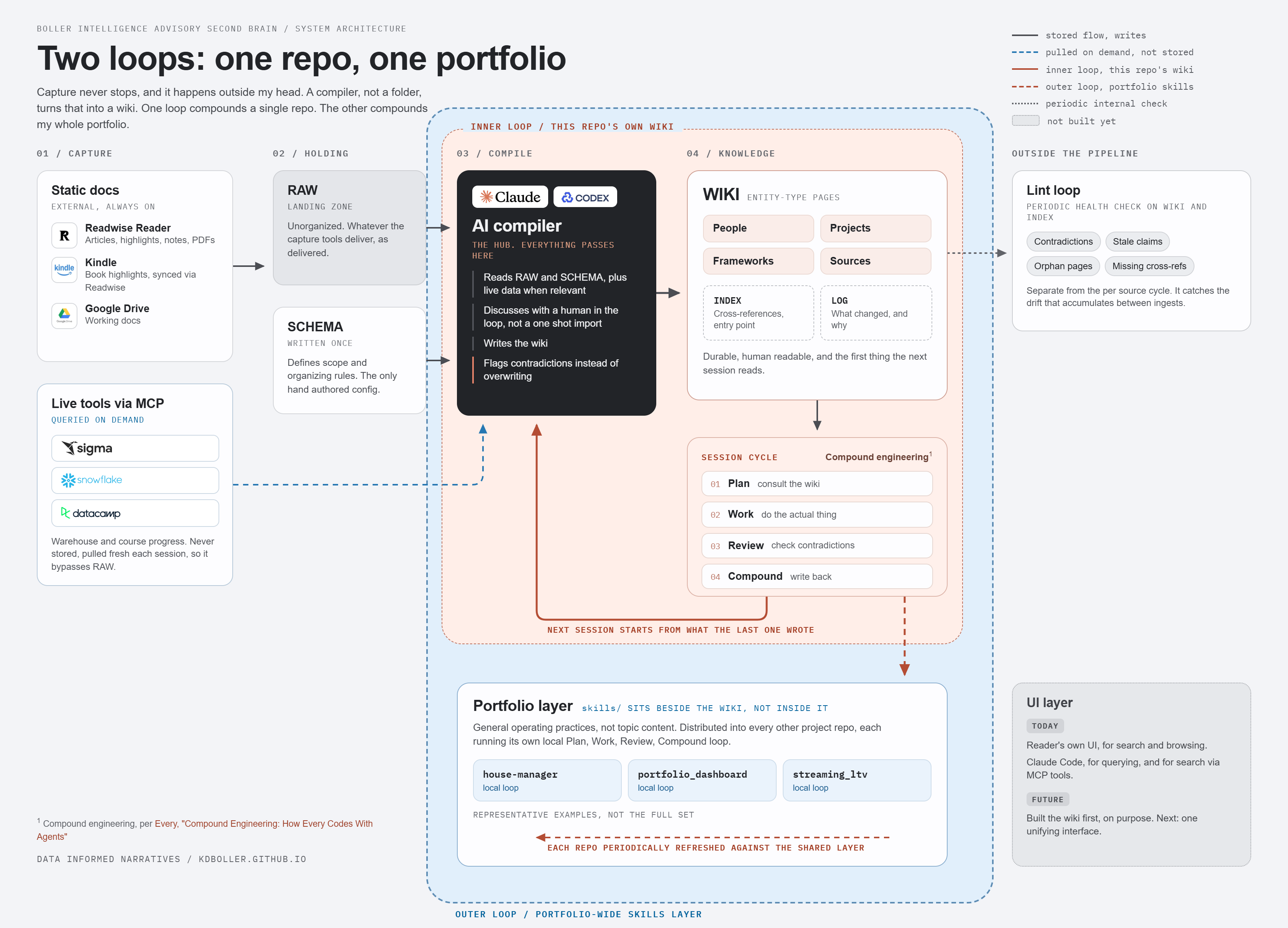
Two loops: one repo, one portfolio - Second Brain system architecture diagram

Building a Second Brain: From Concept Based on Karpathy's Tweet to a Compound Engineering Loop

Since I read Andrej Karpathy’s viral tweet back in April, I’ve wanted to tackle building a ‘second brain’ where an LLM handles the organization, thinking, and maintenance. For as long as I can remember, I’ve had the consistent urge to streamline all that I consume across articles, newsletters, posts, Tweets, YouTube videos, and everything in between. I even created a separate Household Manager harness to manage everything across our family and household. While my Rube Goldberg machine of cobbled-together processes and tools worked alright, the room for improvement grew starker as I learned about implementations that “rode the latest AI model” capabilities. The gap was sharpest around continual improvement that compounds over time: a system that gets smarter with everything you feed it, instead of starting over from zero each session. ...

September 9, 2026 · 5 min · Kevin Boller

Second Brain: AI Compiler & Compound Engineering System

Inspired by Andrej Karpathy’s “second brain” concept, this is a git-backed system where an LLM handles the organization, thinking, and maintenance of everything I consume and everything I build. Capture: Readwise Reader is the inbox and ingestion layer for articles, highlights, forwarded emails, and uploaded PDFs, plus Google Drive for working docs. Live external tools (DataCamp, Sigma, Snowflake, Gmail, Calendar) are queried on demand via MCP rather than statically stored, so structured, dynamic data sits alongside all ingested document knowledge. ...

September 9, 2026 · 2 min · Kevin Boller

Family FIRE Dashboard (Streamlit + PostgreSQL)

Built a multi-page financial planning dashboard in Streamlit + PostgreSQL to model a 40-year household projection, inspired by FIRE (Financial Independence, Retire Early). Upgraded from a scenario-based Excel financial model to a fully interactive, database-driven application with significantly expanded scenario and sensitivity analysis capabilities. Key technical work: Stood up a 40-year per-account projection engine modeling investment accounts (taxable, tax-deferred, Roth, real estate), variable income schedules, and year-by-year surplus/deficit cash flows routed through a designated buffer account Designed a PostgreSQL schema (7 tables) for named scenarios with full assumption, balance, income, expense, and mortgage data. All editable in-app with changes persisted back to the DB, a significant upgrade from the Excel model Built a Sensitivity Analysis page with color-coded HTML tables (nominal and inflation-adjusted) showing investable assets at Year 10 across a growth rate × annual expense matrix; each cell calls the projection engine directly to guarantee exact match with the Overview page Built a Compare Scenarios page with side-by-side KPI cards with deltas, dual line charts (nominal + inflation-adjusted), and a 10-year side-by-side detail table including inflation-adjusted investable asset columns Added an Expenses page with editable budget categories and a Mortgage page backed by a cumulative amortization schedule in Postgres, both with save-to-DB functionality Implemented Altair/Vega-Lite charts throughout: assets over time, account breakdown, income vs. expenses, scenario comparison lines, and mortgage amortization Full dashboard: 6 pages, projection model, sensitivity engine, and schema. Built iteratively with Claude Code from the Excel model foundation and completed in ~3 hours

May 30, 2026 · 2 min · Kevin Boller

Streaming Analytics Dash → Sigma Data Model and Workbook

Ported a Claude Code-developed, synthetic Netflix streaming analytics HTML dashboard (4 tabs, ~10K subscribers, 105K watch sessions) to a production Sigma workbook, rebuilding the Python data pipeline from scratch in order to generate Sigma-compatible CSVs that were added to and power a Sigma data model. Key technical work: Rewrote sigma_export.py, expanding output from four CSVs to nine; added waterfall.csv, top_titles.csv, top_titles_by_plan.csv, device_summary.csv, and monthly_views.csv as pre-aggregated files for charts that could not be derived cleanly in Sigma from grain-level session data Applied all notebook transformations at row level: device watch/completion multipliers, seasonality on watch duration, plan duration/completion multipliers; device session count overrides and monthly seasonality on counts/rates handled in pre-aggregated files Added subscription_plan dimension to cohort_retention.csv and waterfall.csv so that the plan filter control on the LTV tab correctly targets all three data sources Completed in Sigma: LTV tab (all 4 charts + KPIs with working plan filter) and Content tab (all 5 KPIs + 4 charts across 4 data sources)

April 28, 2026 · 1 min · Kevin Boller

Streaming Analytics Dashboard using Claude Code

I recently collapsed several days of work into roughly three hours, and the end result was better than what I would have produced the traditional data science way. The project followed a familiar path: read files into a Jupyter notebook, work through EDA and data transformations to understand what I have and figure out how to best synthesize and present my findings. The key difference for this project is that I used Claude Code throughout. ...

April 23, 2026 · 1 min · Kevin Boller